






Big sports companies around the world want to show their games live to many people. Thinking about how services like abc live tv work helps us understand their big needs. In 2026, it’s not just about putting a game on TV. It’s about getting that game to phones, tablets, and computers everywhere, all at the same time and with great quality. This is called enterprise live streaming, and it has many tricky parts for global broadcasters.

One major problem is how much it costs to share live sports around the globe. Keeping a high-quality picture and clear sound for viewers in different countries is also a big challenge. Imagine trying to make sure everyone sees the same clear game, whether they are in New York or London. Also, broadcasters need to reach fans on many different devices. This means being able to send the broadcast to a regular TV, but also to online apps. These types of broadcasts, which include what you might see on an ion tv schedule or a broadcast tv schedule, need strong setups to work right Enterprise Live Streaming Guide: Platforms, Architecture, Security.
Another tough part is dealing with many different companies for one broadcast. You might need one company for cameras, another for sending the signal, and another for showing it online. This can get very confusing. On top of that, viewers expect to see the game happening almost instantly, with very little delay. This means broadcasters need super-fast, "low-latency" streaming. Mastering all these parts can be a big headache for global sports companies mastering global sports broadcasting challenges.
To learn more about how to handle these big broadcasting challenges, you can Learn More About TPT Global.
When we talk about a service like abc live tv, we are really looking at a set of important steps that bring a live event from the stadium to your screen. It’s much more than just a camera and a TV. It involves many parts working together, especially for big global sports events.

Core Service Components for Live TV
Every great live broadcast, like what you might see on abc live tv or even local sports channels, relies on several key pieces:
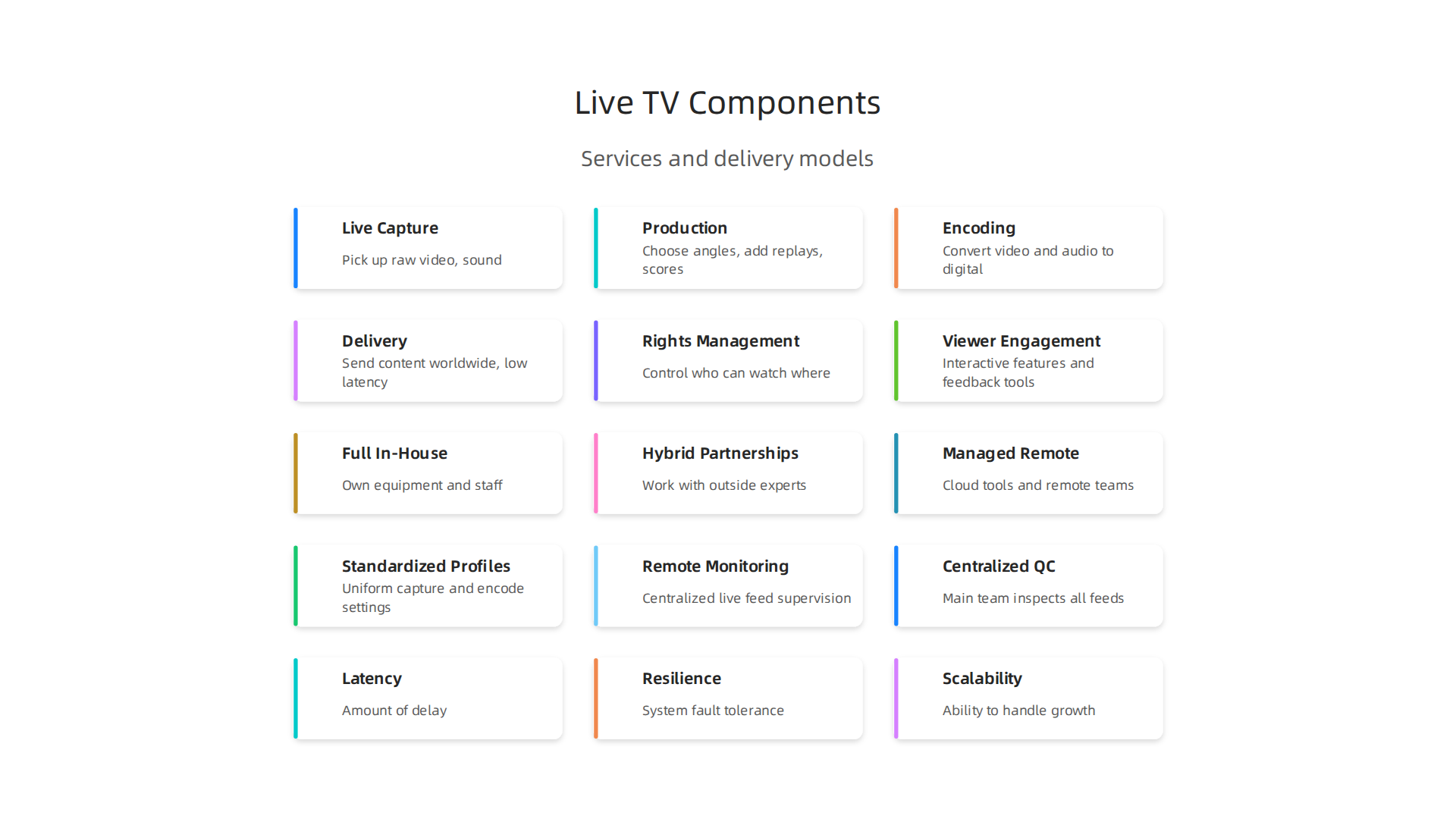
- Live Capture: This is where it all begins. Cameras, microphones, and other tools pick up the raw video and sound from the event. Think of it as gathering all the sights and sounds of the game. These "video sources" are the first part of any live streaming system How to design a Live Video Streaming System Like ESPN.
- Production: After capturing, the raw video goes to a control room. Here, experts choose which camera angle to show, add replays, scores, and graphics. This is also where things like
nuggets entertainmentfor basketball games or other special content get added. This central place makes sure the broadcast looks polished and exciting Comprehensive guide to enterprise livestreaming 2026. - Encoding: Next, the video and audio are turned into a digital format that can travel easily over the internet. This is called encoding. It’s like putting all the big video files into a smaller, travel-friendly package without losing quality.
- Delivery: Once encoded, the content needs to be sent to people all over the world. This often uses special networks called Content Delivery Networks (CDNs). They help make sure the video gets to your device quickly and smoothly, no matter where you are Introduction to Live Streaming Architecture.
- Rights Management: For sports, it’s vital to know who can watch what and where. This component handles all the rules about broadcasting rights. It makes sure that a game meant for viewers in one country isn’t shown in another where a different company has the rights.
- Viewer Engagement: A great live broadcast also thinks about the fans. This includes adding ways for viewers to interact, like polls, live chat, or extra stats. It makes watching more fun and personal.
A good enterprise live streaming service must be able to handle all these parts, from the very start of the broadcast to the very end, and even collect data on how viewers watch How to choose an enterprise live streaming platform.
Delivery Models for Large-Scale Sports
There are different ways to get live sports content to a big audience:
- Linear Broadcast: This is the traditional way, like watching a game on a regular TV channel following an
ion tv scheduleor a standardbroadcast tv schedule. The show starts at a set time, and everyone watches the same thing at the same moment. It’s reliable for mass audiences but less flexible. - Managed Streaming: Here, the broadcast is sent over the internet through a platform that handles all the technical parts. This allows for more control, like showing different ads to different regions, or offering extra features. This is often used by services like
abc live tvfor their online viewers. - Hybrid OTT (Over-The-Top): This model combines the best of both worlds. It uses traditional broadcast methods for broad reach and streaming for digital platforms. This means fans can watch on their TV, computer, or phone, getting a seamless experience no matter how they choose to tune in. This is key for companies wanting to cover a
local liveevent and also reach a global online audience.
No matter the model, the goal is always to deliver a clear, exciting live sports experience to fans. To see some real examples of top-notch production, you can Watch Our Latest Broadcast Work.
Managing all these complex pieces means that live sports production needs a clear, unified strategy. If you want to dive deeper into the kind of end-to-end solutions that make this possible, you can simplify your live sports production.
Making sure live sports events look great and reach everyone, like on abc live tv, can get expensive. As we saw, many parts work together to bring a game from the field to your screen. But a big goal for companies today is to cut down on these costs without making the show any less exciting.

In 2026, companies are always looking for smarter ways to manage their money.
Understanding Costs: Capex vs. Opex
First, let’s talk about the two main types of costs:
- Capital Expenses (Capex): Think of this as buying big, long-lasting things. This includes cameras, special broadcast trucks, editing machines, and studio space. These are big, one-time payments that cost a lot upfront.
- Operational Expenses (Opex): These are the ongoing costs. Things like paying staff, renting equipment for a short time, monthly fees for cloud services, or internet bills. These costs happen regularly.
The cost of putting on live events keeps going up. Things like paying workers, needing more security, and having fancy equipment all add to the bill, as noted in a report on Entertainment & Sports. In fact, labor costs can make up 30% of all expenses for live event production Live Event Production Industry Statistics 2026. Also, sports broadcasting rights themselves are worth a lot of money, climbing to over $67 billion in 2026 across the globe Global sports rights climb to over $67 billion in 2026.
Smart companies are now looking to change how they spend. They want to move away from huge upfront Capex costs and switch more to Opex. This means using flexible, cloud-based systems where you pay as you go. This helps budgets by turning big, unpredictable spending into smaller, regular payments.
Scalable Production Models for Savings
To reduce costs, companies can choose different ways to produce their live sports broadcasts:
- Full In-House Production: This means a company owns all its equipment, hires all its staff, and does everything itself. This gives total control over the
broadcast tv scheduleor theion tv schedule, but it needs a huge upfront investment (Capex). It might work well for a steady, regular broadcast that doesn’t change much, but it’s not very flexible if plans change or new technologies pop up. - Hybrid Vendor Partnerships: With this model, a company does some production in-house but also works with outside experts for certain tasks. For example, they might handle the main camera work themselves but hire a special team for advanced graphics or
nuggets entertainmentsegments. This can save on some Capex and gives access to high-level skills without having to hire those experts full-time. - Fully Managed Remote Production: This is a very modern way to produce live events, especially for a service like
abc live tv. It means using cloud-based tools and experts who work from different places. They can capture video at the stadium, then send it over the internet to a virtual control room where it’s produced. This model turns most of the costs into Opex, as you only pay for the services and cloud space you use. It’s super flexible and can easily grow or shrink depending on the event size, making it perfect for taking alocal livegame to a global audience without needing lots of expensive gear at every location.
Choosing the right production model can greatly help companies manage costs better while still delivering amazing live sports broadcasts to fans everywhere. It’s all about working smarter, not harder.
If you are looking to streamline your broadcast operations and make them more cost-effective, we invite you to Request a Broadcast Consultation to explore the best options for your enterprise. You can also dive deeper into how companies are tackling these complex challenges by learning how to mastering global sports broadcasting challenges.
Even when companies work smarter to save money, it’s still super important that the live sports events they show look great everywhere. Imagine watching a game on abc live tv in one country, and it looks perfect, but in another country, it’s blurry or has bad sound. That would not be good. So, getting the same high quality across many different places, called geographies, is a big challenge.
Maintaining consistent broadcast quality across multiple geographies
Making sure every fan, no matter where they are, sees the best version of the game means having smart plans in place. This is true whether it’s the regular broadcast tv schedule or a special event on the ion tv schedule.
Technical Best Practices for Quality
To keep quality high everywhere, companies use clever technical tricks:

- Standardized Camera and Encoding Profiles: Think of this like taking pictures with the same kind of camera settings and developing them the same way. All cameras used for an event should capture video in a similar way. Then, when that video is turned into a digital file (encoded), it should also use the same settings. This makes sure the picture quality and colors look consistent for all viewers. It also helps with the huge amount of data that live sports production now creates, as it’s becoming a kind of data race to get the action out fast.
- Remote Monitoring: This means having people watch the broadcast from a central place, even if the game is happening far away. They can see what the picture looks like, check the sound, and make sure everything is running smoothly. If something goes wrong, they can fix it quickly, often through cloud services. This kind of operation supported a massive number of live transmissions and data for customers across many countries in 2026, showing how important it is to deliver a high volume of data.
- Centralized Quality Control: This is like having a head coach for broadcast quality. One main team or system checks all the different video feeds and sounds from around the world. They make sure everything meets the highest standards before it goes out to fans.
Operational Tactics for Global Reach
Beyond the technical side, companies use smart operational plans:
- Local Trusted Vendors: Sometimes, it’s best to work with local experts in different countries. These local teams understand the specific needs, rules, and even language of their region. They can help with equipment setup or on-the-ground support for a
local liveevent. This way, the main company doesn’t have to send its own staff and gear everywhere. - Global Playbooks: These are like instruction manuals that everyone follows, no matter where they are. They cover everything from how to set up cameras to how to handle interviews or
nuggets entertainmentsegments. Having clear rules helps make sure the final show looks and feels the same, whether it’s produced in New York or London. - Redundancy Strategies: This means having backup plans for everything. If one camera stops working, there’s another ready. If an internet connection goes down, there’s a backup. These plans help make sure the broadcast never stops, even if there are problems.
By using these technical and operational strategies, companies can make sure their live sports broadcasts are top-notch and consistent, no matter where fans are watching. This helps to deliver flawless global live sports broadcasts for maximum fan engagement and ensures a great viewing experience for everyone.
To see how top-tier broadcast solutions can make a real difference in delivering your content globally, we invite you to Explore Our Broadcast Services.
Once top-notch broadcast quality is locked in, the next big step is making sure that great content reaches everyone, no matter how they like to watch.

In 2026, people watch sports in many ways, not just on a single screen. This means companies have to be smart about how they send out games and sports shows.
Mapping Audience Pathways
Think about all the places fans tune in. Some still love traditional television, catching games on their local abc live tv channel or following a specific ion tv schedule. Others prefer streaming apps on their phones, tablets, or smart TVs. Social media also plays a huge role, with fans sharing quick clips and highlights, often called nuggets entertainment. There are also special online platforms, known as OTT portals, which can even offer local live content tailored to certain areas. Experts note that by 2026, platforms like YouTube have become central to how fans engage with sports, including live games and commentary The 2026 Media Playbook for Sports..
Rights Management and Geo-Restrictions
Getting content to all these places isn’t as simple as just pressing a "send" button. A major challenge is "rights management." This means getting the legal permission to show a game in a specific country or on a certain type of platform. For example, a sports league might sell the rights for its games to different broadcasters in different regions. This can lead to complex deals, like the one the Mountain West Conference made in 2026, involving CBS Sports, FOX Sports, The CW Network, and Kiswe to reach various audiences Mountain West Announces New Media Rights Package in ….
Another key part is "geo-restriction," which makes sure that content is only shown where it’s legally allowed. If a company only has rights to broadcast a game in North America, they must block viewers in Europe from seeing it. This avoids legal trouble and respects the agreements made with other broadcasters worldwide. Managing these rights and restrictions is crucial for any online sports platform in 2026 Sports OTT in 2026: The complete infrastructure playbook. How these deals are set up and where the content goes matters a lot for who holds the power in sports rights today Who Holds The Power in Sports Rights in 2026.
Packaging Content for Platform-Specific Delivery
Because audiences use so many different platforms, the same live sports feed needs to be "packaged" in various ways. What works for a traditional broadcast tv schedule might not be best for a small phone screen or a social media clip. This means changing how the video is encoded, adding different graphics, or even providing different commentary for various regions. Many rights holders are now choosing to "diversify their streaming" and offer content in different ways to suit traditional TV and newer online platforms How Streaming and Tech Giants Are Transforming ….
For example, a full game broadcast might go to a linear TV channel, while short highlights and behind-the-scenes moments are sent to social media. Special online platforms often get a version with extra features like stats or different camera angles. Companies like TPT Global help manage this whole process, making sure each platform gets the right kind of content, ready for its audience. Learning how to best choose and manage these platforms is a big part of succeeding in global sports broadcasting Choosing Live TV Channels and Streaming Platforms for Global Sports Broadcasting.
Managing all these moving parts requires special knowledge in media rights and broadcast production. If you are looking for help with these complex tasks, Trans Group offers a wide range of services for sports and media.
Managing the many different ways sports content is sent out can feel like juggling. Each platform, from abc live tv to a tiny social media clip, often needs its own setup and its own team. This can lead to what people call "vendor sprawl," where companies work with many different service providers for each little task. It can get messy and expensive.
Vendor Consolidation vs. Specialist Partners
When you have too many vendors, it’s like trying to conduct an orchestra with a different conductor for every instrument. It can be hard to keep everyone on the same page and make sure the final show, whether it’s on a broadcast tv schedule or a streaming app, looks and sounds perfect. This is where "vendor consolidation" comes in. It means trying to work with fewer companies that can do many different things.
Pros of Consolidating Vendors:
- Simpler Management: Fewer partners mean less paperwork and fewer meetings.
- Better Prices: When you give one company more work, you might get a better deal.
- Consistent Quality: It’s easier to make sure the quality is the same for all your content, like
nuggets entertainmentclips or full games, if fewer hands are involved. Experts say a good first step is to look closely at all your spending with different vendors to see where you can simplify things Vendor Consolidation 2026: A Framework for Smarter ….
But sometimes, having many vendors is a good thing. For very specific jobs, like creating advanced graphics or managing specialized local live feeds, a "specialist partner" might be best. These companies are super good at one thing, and they can bring top-notch solutions that a bigger, more general company might not offer. For important sports events, managing all these partners, whether many or few, needs careful planning Optimizing Vendor Management for Sports Events.
End-to-End Workflows, Governance, and SLAs
Whether you choose to work with one main vendor or a few specialists, making sure everything runs smoothly is key. This is where "end-to-end workflows" become important. It means having a clear plan for every step of the broadcast, from the camera crew at the game to the viewers watching the ion tv schedule at home. Every part needs to work together without a hitch.
To make sure this happens, two main things are crucial:
- Governance: Think of governance as the rulebook. It’s about setting clear rules and ways of working that everyone agrees on. This helps avoid confusion and makes sure decisions are made properly. It includes knowing what each partner is responsible for and how they should communicate Event Vendor Management: The Complete Guide for ….
- Service Level Agreements (SLAs): These are like promises in a contract. An SLA spells out exactly what a vendor must deliver, how well, and by when. For broadcasters, these might include how quickly content is delivered, how complete the data is, and how accurate everything must be Financial Data Vendor Management: A Complete Guide (2026). If a company provides a managed media monitoring service, their SLA would cover things like recording quality and response times Managed Media Monitoring Service For Broadcasters. Setting up good SLAs is crucial for making sure your partners deliver what you expect Vendor SLA Management Guide | Service Level Agreements ….
Finally, "integration checkpoints" are like regular check-ins along the way. These are specific times where different teams or vendors make sure their parts are fitting together perfectly. It’s how you ensure that the video feed from the stadium connects correctly with the graphics, commentary, and final broadcast, no matter if it’s for traditional TV or online streaming.
These steps help simplify all the complex parts of getting live sports to fans. By streamlining processes and using clear agreements, companies can deliver amazing quality without the headache of managing countless moving pieces. TPT Global offers comprehensive solutions to help you manage these complexities. If you’re looking to deliver top-tier global sports broadcasts, you might want to Explore Our Broadcast Services.
For those dealing with the many challenges of sports production, finding a unified, end-to-end solution can make a huge difference in saving costs and boosting quality. Learn more about how to simplify your live sports production with a unified end-to-end solution.
To deliver amazing quality, especially for live sports, getting the action to fans almost instantly is key. This is what "low-latency streaming" is all about. It means making sure there’s very little delay between something happening live and when you see it on your screen, whether it’s on abc live tv or a streaming app. In 2026, people expect to see every play, every goal, without long waits. While some older streaming methods might have delays of 15 to 30 seconds, new technology can bring that down to just a few seconds or even less than one.
Technical Approaches to Low-Latency Streaming
To achieve such speed, broadcasters use special technologies. One common way is called CMAF/LL-DASH. This method breaks the video into very small pieces, or "chunks," often just 200 to 500 milliseconds long. These small chunks are sent out quickly, so viewers get the video almost as soon as it’s ready. With these methods, the delay can be brought down to about 2 to 5 seconds, which is great for watching local live games. Systems that support "sub-10-second latency" are becoming standard for sports content in 2026, especially those using LL-HLS or LL-DASH protocols Sports OTT in 2026: The complete infrastructure playbook.
For even faster, almost real-time viewing, other methods like WebRTC are used. WebRTC is what powers many video calls you make online, and it can get the delay down to under one second, sometimes as low as 200 to 800 milliseconds, making it great for interactive parts of a broadcast. Other secure ways to send video, like SRT (Secure Reliable Transport) and RIST (Reliable Internet Stream Transport), help make sure the video gets from the event to the viewer without errors, even over regular internet connections. These kinds of protocols are very important for cutting down on delays Low-Latency Streaming Protocols: WebRTC vs LL-HLS vs CMAF (2026) Guide. To make sure these fast streams reach everyone, companies use "edge CDN strategies." This means putting many servers closer to where viewers live. So, if you’re watching nuggets entertainment clips, the video comes from a server nearby, making it load faster and with less lag. Using a multi-CDN approach is key for predictable global performance, especially for live events Scalable OTT Platform Architecture & Tech Stack (2026).
Future-Proofing Broadcast Technology
Looking ahead, keeping up with new broadcast technologies means "future-proofing" your systems. This is like building a house that you can easily add rooms to later. It means using "modular, software-defined architectures." In simple terms, this means building your broadcast system with parts that can be swapped out or updated easily, much like LEGO blocks. Instead of using lots of fixed hardware, more and more is controlled by software, which can be changed quickly to fit new needs or new ways to watch a broadcast tv schedule. Cloud-based workflows, for example, allow companies to quickly set up and take down resources needed for specific events without needing to buy a lot of new equipment Revolutionizing live sports and events coverage with unified cloud.
To know if these new systems are working well, we use "measurable KPIs" (Key Performance Indicators). These are clear ways to check how good the service is. For broadcasts, important KPIs include:

- Latency: How much delay there is. We want this to be as low as possible, even for an
ion tv schedule. - Resilience: How strong the system is. Can it handle problems like internet outages without stopping the show?
- Scalability: How much it can grow. Can it handle thousands or millions more viewers easily if a big event happens?
Measuring these things helps ensure that the audience gets the best experience and that the broadcast system is ready for whatever comes next. Mastering how to measure these aspects is key to mastering global sports broadcasting for worldwide fan engagement.
If you want to see how these cutting-edge broadcast technologies look in action, you can Watch Our Latest Broadcast Work. Understanding these technical details is important, but choosing the right partner to implement them is just as vital. Learn more about Why Choose TPT Global.
Summary
This article explains how modern sports companies deliver global live broadcasts — from stadium cameras to phones, TVs and OTT platforms — and why mastering that pipeline matters for reach, quality and cost. It walks through the core technical components (capture, production, encoding, delivery, rights and engagement), describes delivery models (linear, managed streaming, hybrid OTT), and compares production strategies that trade Capex for flexible Opex. The piece covers how to keep consistent picture and sound across regions using standardized profiles, remote monitoring and redundancy, and how to map audience pathways while enforcing geo-restrictions. It also reviews vendor management, SLAs and end-to-end workflows, plus low-latency options (CMAF/LL-DASH, WebRTC, SRT/RIST) and measurable KPIs to future-proof broadcasts. After reading, you’ll understand practical models and technical choices to cut costs, scale globally, and deliver low-latency, high-quality live sports to diverse platforms.