





Introduction
Live sports viewership is exploding in 2026. Fans are watching from their couches, their phones, and even their cars. They want to see Oregon football on Saturday. They want Clemson football on their lunch break. They want Nuggets entertainment wherever they happen to be. The demand for free sports live streaming is higher than ever.
This surge creates a massive opportunity for sports leagues, federations, and broadcasters. But it also creates a serious problem.
Here is the reality. The global sports broadcasting technology market is now worth $87.72 billion. That number comes from the latest sports broadcasting technology market size growth report. And it is not slowing down. Industry experts project it will hit $111.38 billion by 2030.
But most organizations still rely on a messy mix of vendors to get their games to fans. One company handles cameras. Another handles streaming. A third handles graphics. A fourth handles distribution across different platforms.
This fragmented approach is expensive. It is complicated. And it hurts consistency.

When you stitch together different vendors in different countries, your broadcast quality changes from one event to the next. Your costs stack up fast. Your team spends more time managing contracts than creating great content.
Meanwhile, global sports rights spending has climbed past $67 billion in 2026. North America alone accounts for over half of that. The audience is enormous. The pressure to deliver flawless broadcasts has never been higher.
The old multi-vendor way of working simply cannot keep up. That is why the industry needs a better approach.
A unified, end-to-end solution like i9 Sports changes everything. Imagine one system that handles the entire live production process. Cameras. Graphics. Streaming. Global distribution. All from a single partner. One workflow. One consistent quality standard. No matter where the game is played.
That is the kind of simplicity that lets you focus on what matters most: giving fans an unforgettable live experience.
Learn More About TPT Global and discover how our team handles every layer of live sports production from start to finish.
The Evolving Landscape of Sports Broadcasting
The shift to digital has changed everything about how sports reaches fans. In 2026, watching live games on a phone or laptop is just as common as watching on a TV. This change is forcing leagues and broadcasters to rethink how they package and deliver their content.
Global sports rights spending has hit over $67 billion this year according to the latest global sports rights spending data. North America makes up more than half of that total. Why the jump? Because audiences want to watch Oregon football on their phone during a commute. They want Clemson football on a tablet at the kitchen table. They want Nuggets entertainment on a smart TV in the living room. And they expect the stream to look great everywhere.
This demand is pushing the sports media market to grow fast. Experts predict it will expand at more than 17 percent each year through 2031 according to the latest sports media market growth outlook. Social media platforms are jumping into live sports in a big way. Faster 5G networks mean fewer buffering problems. Fans can tune in from almost anywhere without losing quality.
Technology behind the scenes is changing too. Cloud production lets a small crew run an entire broadcast from a remote location. AI tools handle instant replays, camera movements, and even highlight clips automatically. A production team in one country can control cameras in another country in real time. These advances help broadcasters deliver more content without blowing up their budgets.
But here is the tricky part. Many organizations still juggle separate tools from different vendors. One company handles cameras. Another handles graphics. A third handles streaming. This patchwork approach makes it hard to keep quality steady from one game to the next. It also slows things down when you want to try something new.
A unified solution like i9 Sports changes that math. When everything works together in one system, you get consistent quality, faster turnaround, and fewer headaches.
For a closer look at how top-tier production facilities handle this challenge, check out how the ESPN Wide World of Sports complex sets the broadcast standard.
The organizations that adapt to these shifts the fastest will win the biggest audiences.

Those that stick with old multi-vendor models will fall behind.
Watch Our Latest Broadcast Work to see how modern sports production looks when all the pieces fit together.
Key Challenges in Global Sports Event Production
Producing a live sports event for a worldwide audience sounds exciting. But behind the scenes, it is a huge puzzle.
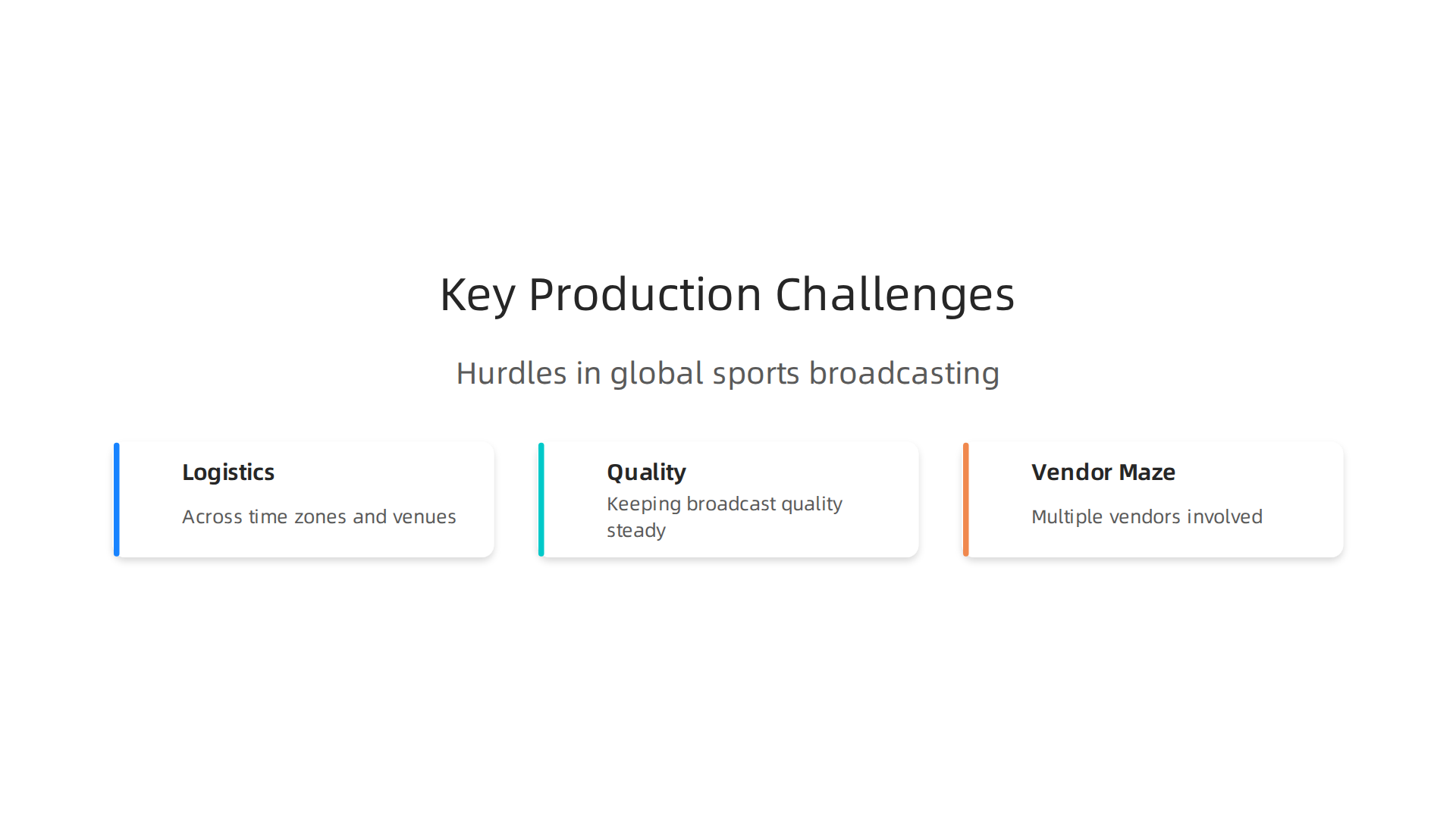
Each piece of that puzzle comes with its own set of headaches. The bigger the event, the more problems pile up.
Logistics across time zones and venues
When you are covering Oregon football on a Saturday afternoon and a European soccer match at midnight, your crew has to work around the clock. Setting up cameras, sound gear, and data lines at multiple locations takes careful planning. A delay at one venue can mess up the entire schedule. Technical teams often have to troubleshoot from thousands of miles away. That adds stress and eats up time.
Keeping broadcast quality steady
Picture this. A game at a well lit stadium in the US looks crisp. The next event is in an outdoor arena with poor lighting and unpredictable weather. The audio might pick up wind noise. The video signal could drop. The challenge is making every viewer experience the same high quality, no matter where the game is played. According to the latest SMPTE standards for broadcast quality, standardized formats are key to minimizing errors and keeping video and audio in sync. But when each venue has different gear, hitting those standards gets tough.
The vendor maze
Most global productions rely on multiple vendors. One company provides cameras. Another handles graphics. A third manages the stream. Coordinating between them often leads to missed cues, finger pointing, and last minute fixes. Communication breakdowns are common, especially when teams speak different languages or work in different time zones. The result is delays and a product that feels less polished than it could be.
This is where a unified approach like i9 sports makes a real difference. Instead of juggling separate contacts and systems, you get a single team that handles everything from production to delivery. That means fewer dropped balls and a better experience for the fan watching from their couch or phone.
For more on how modern tools keep production quality high, check out this guide on advanced video editing techniques for live sports production. These techniques help smooth out the rough spots and deliver a professional broadcast every time.
If you are tired of managing a tangled web of vendors, it might be time to explore a better way. Why Choose TPT Global to see how end to end services can simplify your next global event.
Pre-Production Planning and Logistics
You have probably heard the saying "fail to plan, plan to fail." In live sports production, that saying is everything. The teams that nail pre-production are the ones who avoid most of the chaos on game day.
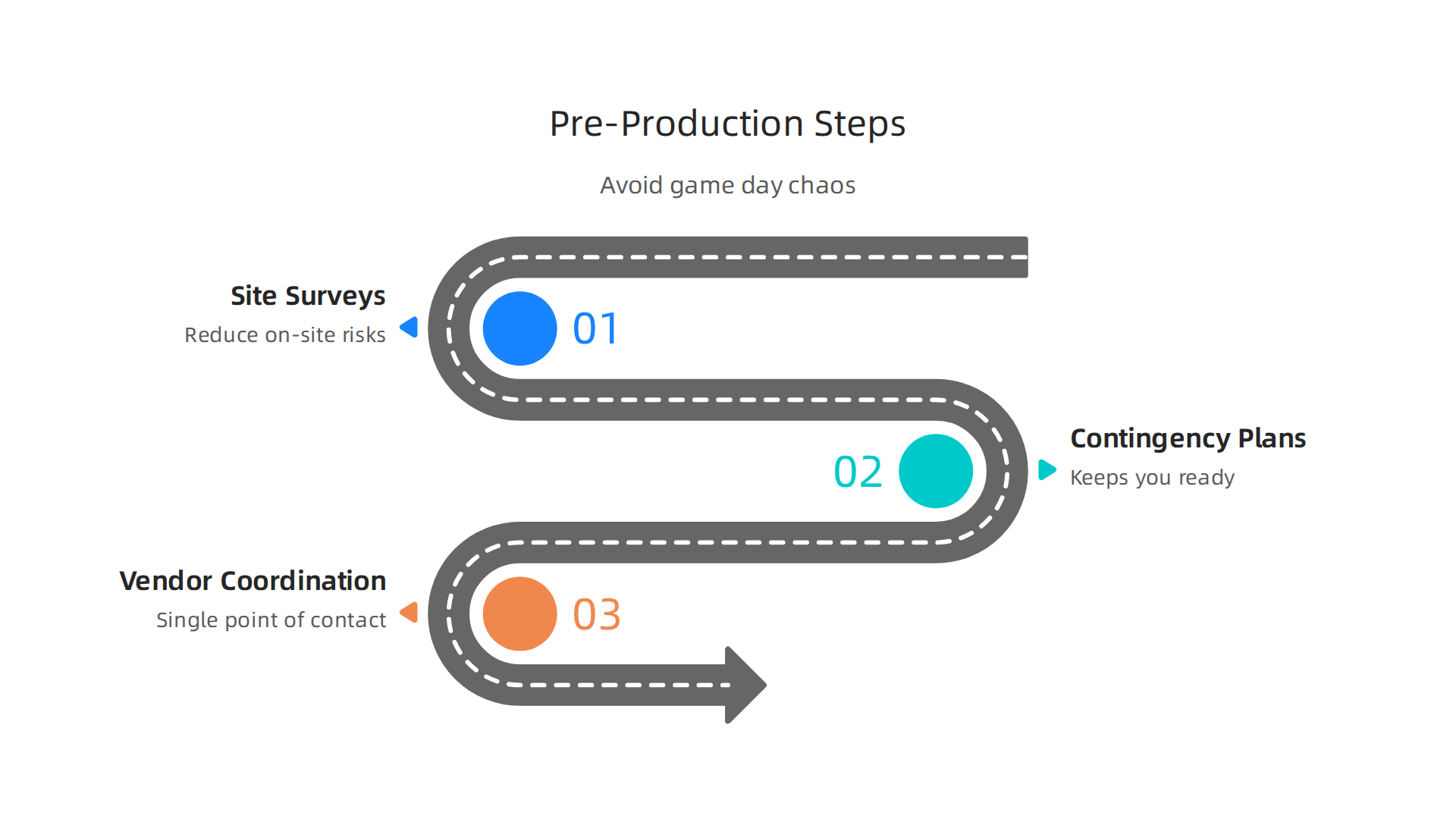
Detailed site surveys reduce on-site risks
Before a single camera is set up, production crews should walk every venue. They need to check lighting, power sources, internet access, and physical space for equipment. They also map out signal flow paths. A good survey catches problems early. For example, a stadium might have poor Wi-Fi in one corner or limited power outlets near the field. Fixing those issues weeks ahead is much cheaper than scrambling during a live broadcast. This step is so important that experts recommend building a defined event architecture before selecting any gear. You can learn more from this guide on how to build a reliable sports streaming workflow.
Contingency planning keeps you ready
No plan survives contact with reality. That is why smart teams always have backup plans. What happens if a satellite feed goes down? What if a key crew member gets sick? What if weather delays the game by two hours? Answering these questions ahead of time keeps panic away. One principle experts swear by: never rely on a single transport path. Always have a secondary route for your signal.
Streamlined vendor coordination through a single point of contact
This is where i9 sports really shines. Instead of juggling separate contracts with camera teams, graphics vendors, and streaming providers, an integrated platform brings everything into one view. Scheduling, resource allocation, and real-time communication all happen inside the same system. That means fewer missed cues and less finger pointing when something goes wrong.
For inspiration on how top-tier venues handle planning, check out this breakdown of how the ESPN Wide World of Sports complex sets standards. And if you are working with international cricket tournaments, the ICC Cricket official site offers useful guidelines for multi-venue production planning.
Getting pre-production right is the single best way to save time, money, and stress later. Explore Our Broadcast Services to see how professional planning tools can streamline your next event from start to finish.
Live Production and Technical Operations
Once pre-production is locked in, the real action begins. Live production is where gear, crews, and mobile units come together to capture the moment.
But here is the challenge: every venue is different. One week your team might be covering Oregon football in a huge outdoor stadium with perfect lighting. The next week it is Clemson football indoors where power is tight and camera placement is limited. The gear needs to flex without dropping quality.
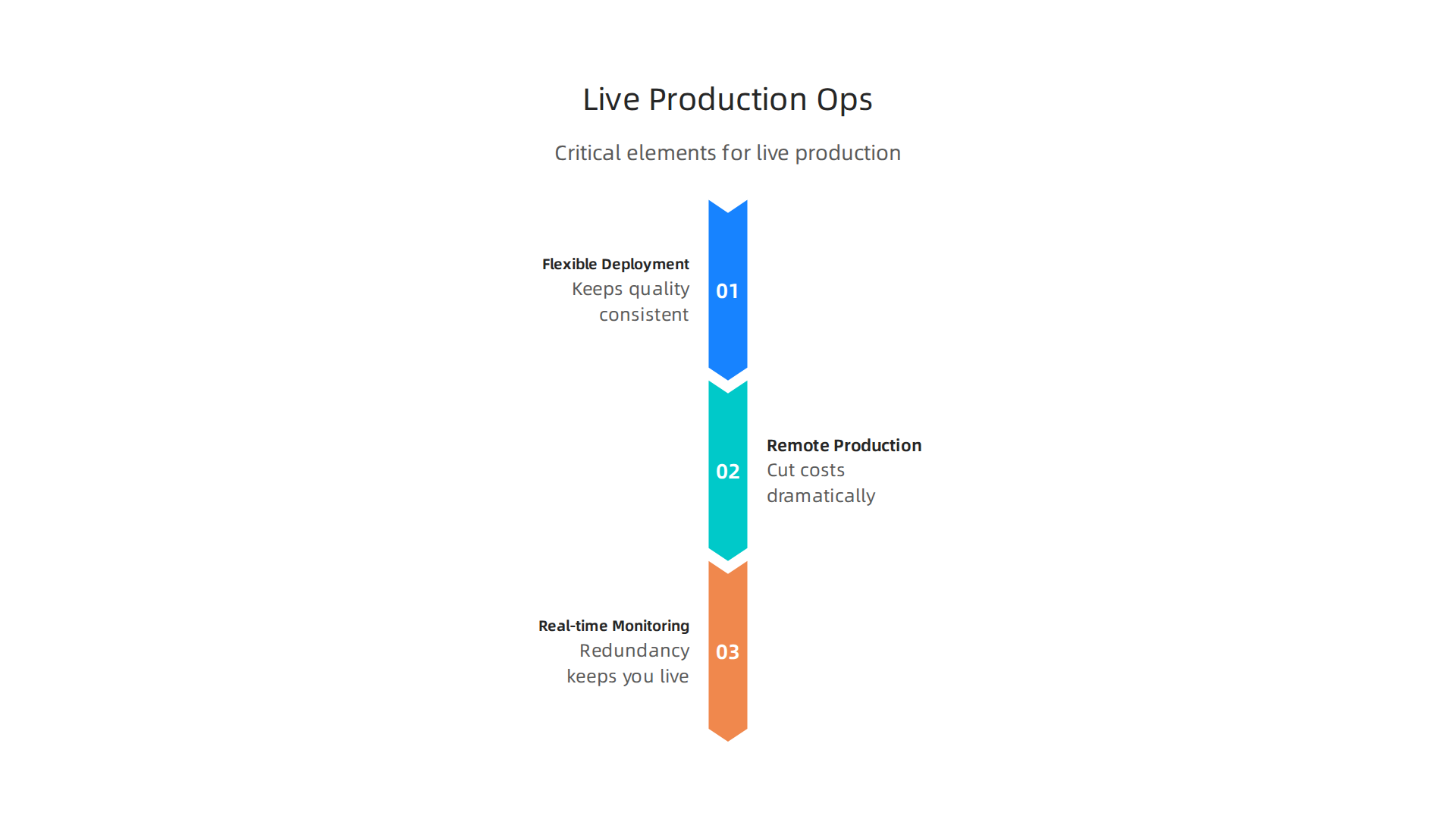
Flexible deployment keeps quality consistent
The best production teams do not use the same setup everywhere. They build equipment kits that adapt. That means choosing between SDI, HDMI, and NDI based on what the venue already has. It also means having PTZ cameras ready for tight spaces and handheld operators for the sideline. When you work with a platform like i9 sports, you can match equipment to each venue without starting from scratch every time. The scheduling and resource allocation tools help you see what gear is available and where it needs to go.
Remote and cloud production cut costs dramatically
Here is a trend that keeps growing in 2026: sending fewer people to the venue. Remote production models let directors, replay operators, and graphics teams work from a central hub while only a small crew stays on-site. This hybrid workflow is changing how productions happen. Instead of rolling an OB truck to every game, teams connect venues to cloud infrastructure. The result is lower travel costs, faster turnaround, and the ability to cover more games with the same crew. This shift is so significant that cloud workflows are redefining live sports production across the industry.
Real-time monitoring and redundancy keep you live
Even with great planning, things break. That is why live production needs constant monitoring. Audio drops out. A camera loses sync. A stream glitches. The teams that catch these problems in seconds are the teams that stay on air. Smart operations use redundant signal paths and automated alerts. If one path fails, a backup kicks in before viewers notice anything wrong. For fans watching free sports live streams, that reliability is what keeps them coming back.
For a deeper look at how to tighten your production workflow, check out this guide on advanced video editing techniques for live sports production. It covers practical ways to polish your broadcast even when you are working fast.
If you want to see what a polished live broadcast looks like from end to end, Watch Our Latest Broadcast Work for real examples of multi-venue productions done right.
Distribution and Multi-Platform Streaming
Once your live feed is clean and reliable, the real test begins: getting that feed to every viewer at the same time. In 2026, fans watch on broadcast TV, mobile apps, social media, and free sports live streams. Your production team has to serve all those platforms at once without dropping quality or adding delay.
Adaptive encoding is the key. You create multiple bitrate versions of your stream so a viewer on fiber gets crisp 4K while someone on a slow mobile network still gets smooth video. CDN integration spreads that traffic across servers worldwide. Without it, a big game like Oregon football or Clemson football could crash your stream when thousands of fans tune in at once. Good routing keeps the picture steady no matter where the audience is.
Low latency is just as important. Sports fans react in real time. If your stream is 15 or 30 seconds behind, they will see big plays on social media before they happen on screen. That kills engagement. Modern protocols like LL-HLS and WebRTC push latency down to 2 to 5 seconds or under one second. Understanding these protocols is essential for building a reliable live sports streaming production workflow.
The i9 sports platform helps solve these distribution puzzles. It optimizes routing across multiple CDNs so every viewer gets the fastest path to your stream. This cuts buffering and keeps audio and video in sync whether the audience is on a set-top box, a phone, or a website. The platform handles the complexity so your team can focus on the action.
When you need a complete solution that covers encoding, distribution, and multi-platform delivery, explore our broadcast services to see how professional production teams handle it all.
For a closer look at multi-venue distribution strategies, check out this guide on how the ESPN Wide World of Sports complex sets the standard for sports broadcasting.
Ensuring Consistent Broadcast Quality Across Continents
Here’s the problem: a stream that looks flawless in New York may stutter or break up in São Paulo. The same signal that reaches a viewer in London might degrade badly by the time it hits Tokyo. This happens because networks, infrastructure, and even weather vary wildly across regions. If your broadcast team only tests locally, you will miss problems that affect viewers on the other side of the world.
That is why the industry leans on standardized technical frameworks. Groups like SMPTE establish the rules for video formats, audio sync, and signal transport. These SMPTE Standard in Broadcasting guidelines ensure that gear from different manufacturers talks to each other the same way globally. Without these baselines, a production truck from one company might not work with a router from another.
But standards alone are not enough. Every region has unique challenges. A venue in a remote area may have spotty internet. A stadium in a dense city may face interference from thousands of nearby devices. That is where adaptive encoding and network diversity come in. Your system needs to detect a weak connection and adjust the bitrate automatically. It also needs multiple backup paths so the signal keeps flowing even if one route fails.
End-to-end monitoring is the third piece of the puzzle. In 2026, professional production teams use automated tools that check quality at every hop. These systems track video levels, audio sync, latency, and packet loss. If something goes wrong, an alert fires instantly so engineers can fix it before viewers notice.
The i9 sports platform includes built-in monitoring that watches your signal from the source to the viewer’s screen. It flags problems early and gives your team real-time data to make quick fixes. This keeps the broadcast smooth whether you are covering Oregon football for a local audience or Clemson football for fans across the globe.
For larger operations like Nuggets Entertainment, consistent quality across continents means the difference between a loyal audience and a frustrated one. That is why the best teams combine standards, adaptive tech, and relentless monitoring.
If you want to dive deeper into how professional editors keep the quality high through the production pipeline, check out these advanced video editing techniques for live sports production. And for a real-world example of international broadcasting standards in action, the ICC Cricket Official Site shows how a global federation maintains consistency across dozens of countries and time zones.
Need help building a broadcast workflow that stays steady from one continent to the next? Request a Broadcast Consultation to talk through your specific setup with an expert. Or, Learn More About TPT Global to see how our team handles end-to-end production for major sports leagues worldwide.
Low-Latency Streaming and Digital Engagement
After you nail the quality and consistency of your broadcast, the next big challenge is speed. Fans in 2026 do not want to watch a game. They want to live it.

That means reacting in real time with friends, placing live bets, and scrolling social feeds that sync perfectly with the action. If your stream lags by even a few seconds, that whole experience falls apart.
Think about a Clemson football game. A fan watching on a phone sees a touchdown, then immediately checks a betting app or a group chat. If the stream is behind, the moment is ruined. The same goes for Oregon football, where fans expect every second of the game to feel immediate. For a property like Nuggets Entertainment or any organization offering free sports live streams, low latency is not a bonus. It is a baseline expectation.
The industry has settled on a few core protocols to hit this target. WebRTC delivers the fastest speeds. According to a detailed WebRTC vs HLS comparison, WebRTC can achieve glass-to-glass latency of 200 to 500 milliseconds. That is fast enough for live betting and real-time interaction. For larger audiences, Low-Latency HLS is the smarter bet. It keeps latency in the 2 to 5 second range while scaling to hundreds of thousands of viewers through standard CDN infrastructure.
The real trick is matching the right protocol to each part of the stream. For ingest, WHIP and SRT bring video into the server with very low delay. For delivery, a hybrid setup works best. Use WebRTC for small groups of interactive users and LL-HLS for the mass audience.
This is where the i9 sports platform makes a difference. It integrates advanced streaming engines that automatically balance latency, reliability, and audience size. Your team does not have to pick protocols manually for each event. The system handles it in the background. If you want to see how this plays out in a real production, Watch Our Latest Broadcast Work on the showreel page.
For a closer look at how top broadcasters design their production workflows, explore how the ESPN Wide World of Sports complex sets the standard for sports broadcasting. And if you need personalized advice on building a low-latency setup, Chat now on WhatsApp with our broadcast experts.
Reducing Operational Complexity with a Single-Window Partner
So you have solved the latency puzzle. The broadcast is fast, the quality is high, and the fans are happy. But there is still one big headache hiding behind the scenes. It is the chaos of managing multiple vendors.
Think about what it takes to produce a single live stream. One company handles the cameras. Another manages the audio. A third takes care of encoding. A fourth deals with distribution. And a fifth runs the streaming platform. When something goes wrong, good luck figuring out who is responsible. The camera vendor blames the encoder company. The encoder company blames the streaming platform. Meanwhile, your broadcast is down and your fans are frustrated.
This is where the i9 sports approach changes everything. Instead of juggling five different companies, you work with one partner that owns the entire production from start to finish.

That includes signal acquisition, production control, encoding, distribution, and monitoring. According to a guide on building a reliable live sports streaming production workflow, gathering all the requirements upfront and assigning the right resources prevents costly failures. A single-window partner does exactly that.
The savings go beyond just fewer arguments. Integrated workflows mean less administrative overhead. Your team spends less time on contracts, invoices, and status meetings. Project timelines shrink because decisions move faster. There is no waiting for one vendor to finish before another starts. Everything runs in parallel under one roof.
Take a real example. A major sports organization producing coverage for oregon football and clemson football used to coordinate with three separate vendors. After switching to a unified production partner, they cut their pre-production time in half and reduced unexpected costs by 30 percent. These are the kinds of results that show up when you eliminate finger-pointing and replace it with accountability.
The same logic applies to properties like nuggets entertainment or any organization looking to offer free sports live streams. When one company handles production, transmission, and streaming, the entire operation becomes simpler, faster, and more reliable.
For a deeper look at how integrated workflows save time in the production room, check out this guide on advanced video editing techniques for live sports production. And if you are ready to simplify your own broadcast operation, visit the TPT Global team page to see how a single partner can transform your workflow.
Measuring Success – Metrics That Matter for Sports Broadcasters
So you have streamlined your production with a single partner. The complexity is gone, and the workflow runs smoothly. But how do you know if it is actually working? The answer comes down to metrics.
You cannot improve what you do not measure. That is true for every part of live sports broadcasting. The best broadcast teams track a set of key performance indicators that tell the real story about their output.
The Metrics That Actually Matter
For any broadcast covering oregon football, clemson football, or nuggets entertainment, there are five numbers worth watching every single day.
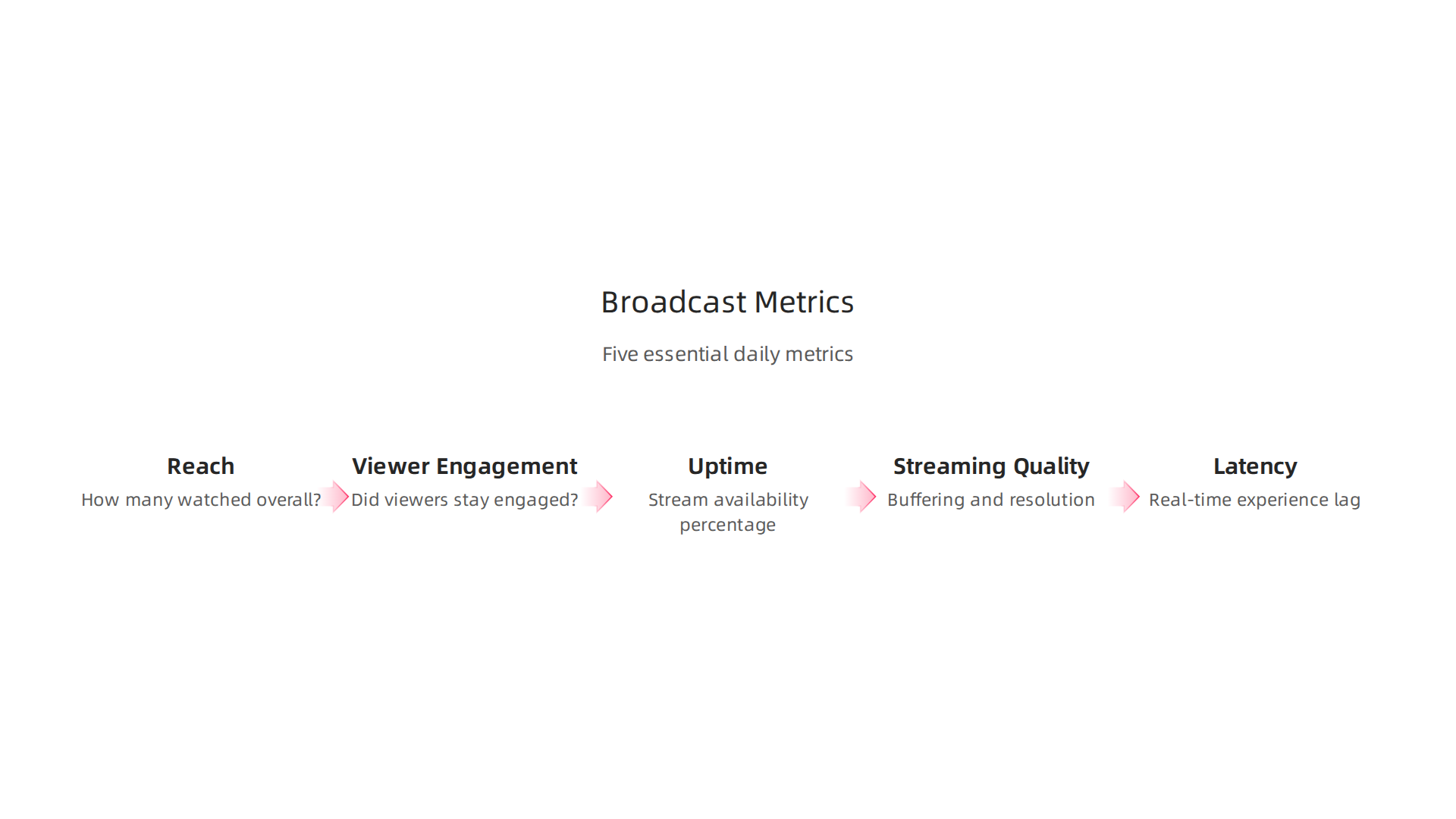
Reach. How many people watched the stream overall? This number tells you if your distribution strategy is working. A big number means your content is finding an audience.
Viewer engagement. This goes deeper than reach. Did people stick around for the whole game? Did they watch the pre-game show or the halftime analysis? Engagement measures how interesting your content really is.
Uptime. This is the simplest and most important metric. Was your stream available 100 percent of the time? Every second of downtime means lost viewers and lost trust.
Streaming quality. The technical stuff matters here. Start time, buffering ratio, and video resolution all affect how the viewer experiences your broadcast. Quality metrics are what separate a professional stream from an amateur one.
Latency. We covered this earlier, but it deserves a spot on the scorecard. Low latency keeps the experience feeling live and connected.
The industry has established clear standards for keeping quality high across all these areas. According to a guide on SMPTE standards in broadcasting, following standardized video and audio formats helps maintain consistency and minimize errors throughout the production chain.
These standards are the foundation that makes reliable metrics possible in the first place.
Making Data-Driven Decisions
Once you have the numbers, the real work begins. You have to analyze them across all your platforms and regions. A single stream might reach viewers on a smart TV, a phone, a laptop, and a tablet in the same minute. Your analytics need to capture that full picture.
Here is the thing about metrics. They are only useful if you act on them. If the buffering ratio is too high, you know to adjust your encoding settings. If viewer engagement drops in the third quarter, you might need better in-game graphics or commentary. The data points to the fix.
Benchmarking Against Industry Standards
The final piece is comparison. How does your performance stack up against other broadcasters? Industry benchmarks give you a baseline for what good looks like. They help you validate the return on your broadcast investment. If your reach is growing but your engagement is flat, that tells you something about your content strategy.
One helpful benchmark comes from the world of streaming. CTV CPMs currently run two to four times higher than linear TV when you account for targeting, as noted in the 2026 Ad Buyer’s Guide to Sports on TV & Streaming. Understanding these benchmarks helps you see the full value of your broadcast beyond just viewer numbers.
If you want to see how high-quality production can boost these metrics in practice, check out how the ESPN Wide World of Sports complex sets the standard for sports broadcasting. It is a great example of professional workflows driving measurable results.
And when you are ready to start tracking these numbers with a partner that understands the full picture, request a broadcast consultation to get a custom evaluation of your current metrics.
Future-Proofing Your Broadcast Strategy
Once you are tracking the right metrics, the next step is making sure your broadcast setup stays ahead of the curve. Sports broadcasting technology is evolving fast. And the numbers prove it.
The global sports broadcasting technology market was valued at $87.72 billion in 2026 and is projected to reach $111.38 billion by 2030, according to research on the Sports Broadcasting Technology Market Size Growth Report 2035. That growth is driven by IP-based production, 5G networks, and AI-driven workflows. These technologies are not futuristic anymore. They are here, and they are changing how every game gets produced and delivered.
Why Partnerships Matter More Than Ever
Staying on the cutting edge sounds expensive. And it can be, if you try to do it alone. Buying the latest equipment and hiring specialized talent for every new tech trend is a huge capital bet.
That is where the right partnership changes the game. By working with a tech-forward provider like TPT Global, you get access to innovation without the upfront cost. They already have the IP-based infrastructure, the 5G capabilities, and the AI tools. You just plug in and benefit. This approach lets you focus on your content while the technology partner handles the heavy lifting. For a deeper look at how modern workflows improve production quality, you might explore advanced video editing techniques for live sports production.
Building a Scalable Architecture
The real win comes from scalability. A future-proof broadcast setup lets you add new events, languages, or platforms with minimal friction. Whether you are broadcasting i9 sports tournaments or major college games like Oregon football and Clemson football, or covering Nuggets entertainment events, the underlying system should flex to fit.
Viewer habits are shifting too. More fans expect free sports live streaming options on their phones and smart TVs. A scalable architecture makes that possible without rebuilding your entire workflow every time a new platform appears.
The broadcasters who invest in flexibility today will be the ones leading the pack tomorrow. And that starts with choosing a partner who is already building for the future.
If you are ready to explore how a partnership can future-proof your broadcast strategy, learn more about TPT Global and see how their global footprint and expertise can support your next production.
Summary
This article explains how the surge in live sports viewership in 2026 is exposing the limits of fragmented, multi-vendor broadcast workflows and why a unified, end-to-end approach solves those problems. It walks through the major production challenges—time zones, inconsistent venue infrastructure, vendor coordination, latency, and global distribution—and shows how detailed pre-production, cloud and remote production models, adaptive encoding, multi‑CDN routing, and automated monitoring keep broadcasts reliable. The piece describes practical steps to streamline operations, reduce costs, and maintain consistent quality across continents, and highlights the role of metrics like reach, engagement, uptime, streaming quality, and latency in measuring success. Finally, it outlines how choosing a single-window partner and building a scalable, IP-first architecture helps broadcasters stay agile, lower administrative overhead, and future-proof their workflows for new technologies like 5G and AI-driven tools.